
Pasta Shapes Chart
Why does ragù go with pappardelle and pesto with fusilli? Pasta shapes are designed to hold different sauces. This interactive chart lists 30 popular shapes by family, with the sauces they suit and typical cooking times, and lets you filter by sauce. The portion calculator then tells you how much pasta, water and salt to use for your number of guests.
- Free to use
- No sign-up
- Runs in your browser
Pasta shape finder and portion calculator
Portion calculator
Pasta Night Printables
Four PDFs (5 pages) are free individually. The $5 ZIP adds an editable Word meal planner and a static Excel pasta reference, with all 7 files including README in one download. Recipe cards are blank short-note cards; no prepared recipes or automatic Excel calculations are included.
- Shapes chart (PDF)
- Portion chart (PDF)
- Meal planner (PDF/DOCX)
- Recipe cards (PDF)
Formats: PDF, XLSX, DOCX. Instant download after payment (link valid 72 hours, up to 5 downloads). AI-assisted: the templates were drafted with AI help and reviewed and laid out before publishing.
$5.00 USD, one-time 4 PDFs + DOCX + XLSX + README
- Instant download
- 7-day refund
- Secure checkout by Stripe
7-day money-back guarantee. Full refund within 7 days of purchase, even after you download.
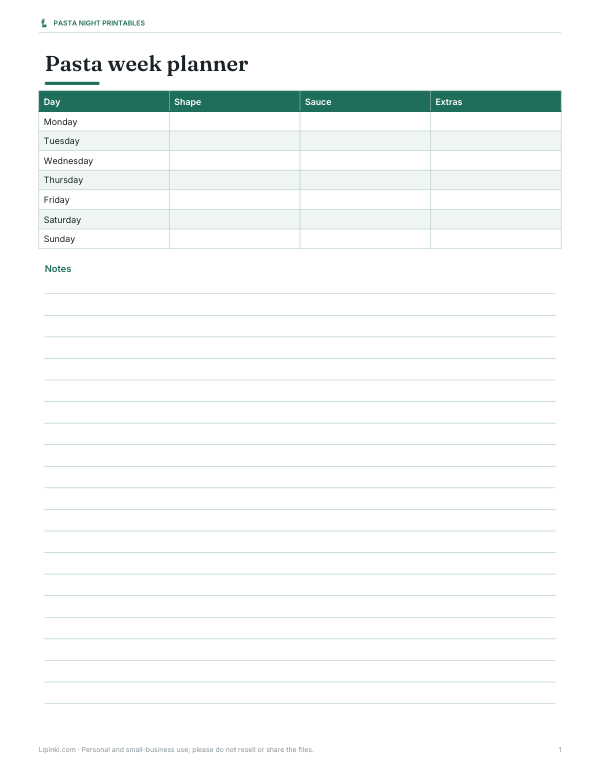
Free sample: Pasta Meal Planner (PDF, 54 KB)
Full refund within 7 days — see the refund policy and license.
Free printables
Single sheets you can print right now, no sign-up. The full pack adds every sheet in one download plus the editable files.
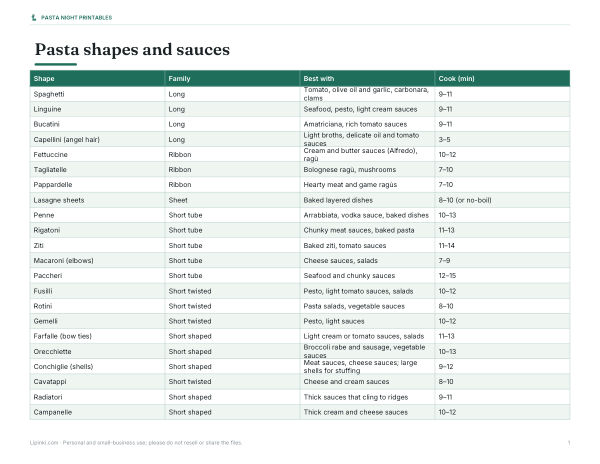
 Printable Pasta Shapes Chart
Matching pasta shapes and sauces
| Family | Examples | Pairs best with |
|---|---|---|
| Long, thin | Spaghetti, linguine, capellini | Oil-based, tomato and seafood sauces that coat each strand |
| Ribbons | Fettuccine, tagliatelle, pappardelle | Butter, cream and meat ragùs — the wide surface holds rich sauce |
| Tubes | Penne, rigatoni, ziti, paccheri | Chunky sauces that get caught inside; baked dishes |
| Twists and spirals | Fusilli, rotini, gemelli | Pesto and light sauces that cling to the grooves; pasta salads |
| Shaped | Farfalle, orecchiette, shells | Sauces with small pieces — peas, sausage, broccoli |
| Soup pasta | Orzo, ditalini, stelline | Broths and minestrone |
| Stuffed | Ravioli, tortellini | Simple butter, broth or light tomato so the filling shines |
The general rule: delicate shapes with light sauces, sturdy shapes with hearty sauces. Ridged pasta (rigate) holds sauce better than smooth.
How much pasta per person
| Serving | Dried pasta | Fresh pasta |
|---|---|---|
| Main course | 75–100 g (2.5–3.5 oz) | 100–130 g |
| Italian-style first course | 60–80 g | 80–100 g |
| Side dish | 40–60 g | 60–80 g |
| Child | 40–60 g | 60–80 g |
US packages often list a serving as 2 oz (56 g) of dried pasta. Dried pasta roughly doubles in weight when cooked; fresh pasta absorbs less water.
How to cook pasta perfectly
- Use a large pot with plenty of water — about 1 litre per 100 g of pasta.
- Bring it to a rolling boil before adding salt (about 10 g per litre) and then the pasta.
- Stir in the first minute so pieces don’t stick.
- Start tasting a minute or two before the packet time; “al dente” means tender with a slight bite.
- Save a mug of the starchy cooking water before draining.
- Toss the pasta with the sauce in the pan for a minute, adding a splash of pasta water to make the sauce glossy.
Worked example
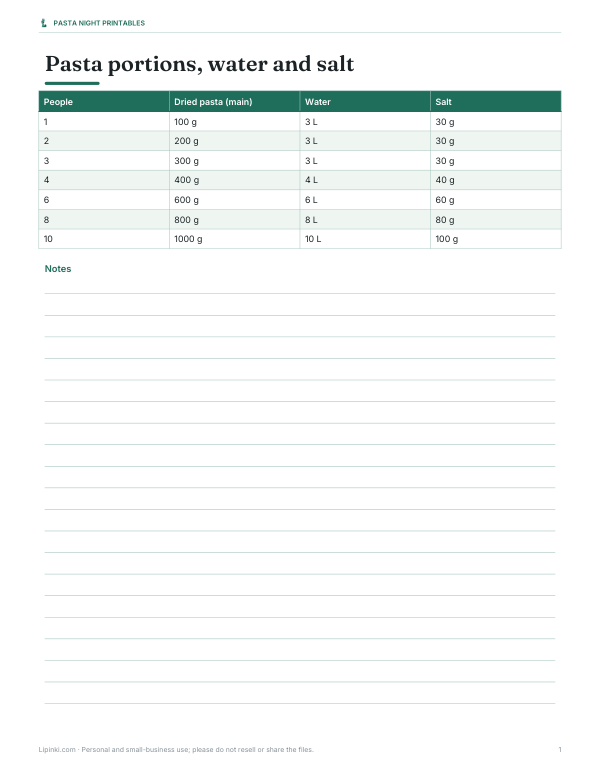
Dinner for four with dried rigatoni as a main course: the calculator suggests 400 g of pasta (100 g each), 4 litres of water and 40 g of salt — about 6–7 teaspoons of table salt. That cooks to roughly 880 g. Searching the chart for “meat” shows pappardelle, rigatoni and conchiglie as shapes suited to a chunky meat sauce, and the typical cooking time for rigatoni is 11–13 minutes.
Fresh vs dried pasta
Fresh egg pasta is soft and rich and cooks in a few minutes; it pairs beautifully with butter and cream sauces and delicate fillings. Dried pasta, usually made from durum wheat semolina and water, has a firmer bite and holds up to robust sauces and baking. Neither is better — they suit different dishes. Many Italian households use dried pasta most days.
Gluten-free and whole-wheat pasta
Whole-wheat pasta has more fibre and a nuttier taste, and suits robust sauces. Gluten-free pasta made from rice, corn, legumes or blends can break more easily — cook it in plenty of water, stir gently and check it early, as it can go from firm to soft quickly. Legume pastas (chickpea, lentil) are higher in protein.
Using the finder
- Choose a pasta family to see its shapes.
- Or type a sauce ingredient — pesto, cream, meat, seafood, tomato — to see shapes that suit it.
- Use the portion calculator for your number of people, course and pasta type.
- Switch units between grams and ounces.
Timing pasta and sauce together
Start the sauce first — most need longer than the pasta. Put the water on to boil while the sauce simmers, then cook the pasta so it finishes a minute before the packet time. Transfer it straight into the sauce pan with a little cooking water and let it finish there for a minute; the pasta absorbs flavour and the starch helps the sauce cling.
Regional classics
| Region | Classic pairing |
|---|---|
| Rome and Lazio | Spaghetti or rigatoni carbonara; bucatini all’amatriciana |
| Bologna and Emilia-Romagna | Tagliatelle al ragù; tortellini in brodo |
| Genoa and Liguria | Trofie or linguine with pesto |
| Puglia | Orecchiette with broccoli rabe |
| Naples and Campania | Paccheri with seafood; spaghetti with clams |
Buying good dried pasta
Look for pasta made with 100% durum wheat semolina. “Bronze-cut” or “bronze-drawn” pasta is pushed through bronze dies that leave a rough, slightly chalky surface that holds sauce well, while cheaper Teflon-cut pasta is smoother and shinier. Slow-dried pasta often keeps its texture better when cooked.
Storing leftovers
Cool cooked pasta quickly and refrigerate in a covered container for up to 3–5 days. Reheat with a splash of water or sauce. Plain cooked pasta can be frozen for about two months; toss it with a little oil first to stop it sticking.
Frequently asked questions
Which pasta shape is best for pesto?
Twisted shapes like fusilli and gemelli, or long pasta such as linguine.
What pasta goes with meat sauce?
Wide ribbons like pappardelle and tagliatelle, or tubes like rigatoni.
How much dry pasta per person?
About 75–100 g (2.5–3.5 oz) for a main course.
How much salt in pasta water?
About 10 g per litre.
Does pasta double when cooked?
Dried pasta roughly doubles in weight.
How long does fresh pasta take?
Usually 2–5 minutes.
Should I add oil to pasta water?
It isn’t needed; stirring early and using plenty of water stop sticking, and oil can make sauce slide off.
What does al dente mean?
“To the tooth” — cooked through but still slightly firm when bitten.
How much pasta for 10 people?
About 1 kg (2.2 lb) of dried pasta for a main course.
Which pasta shapes are best for soup?
Small shapes such as orzo, ditalini and stelline.